Apple Copland: The Mac OS 8 That Never Shipped
By Retro Techie
Introduction
In the mid-1990s, Apple promised its users a brand-new, modern operating system. Its code name was Copland, and it was meant to become Mac OS 8, the biggest upgrade to the Macintosh since 1984.
Apple Copland never shipped. After years of development, slipping deadlines, and a huge engineering budget, Apple canceled the project in 1996. That failure led directly to Apple buying NeXT, bringing Steve Jobs back, and building Mac OS X.
Here’s what Copland was supposed to be, why it collapsed, and why it still matters for Mac history.
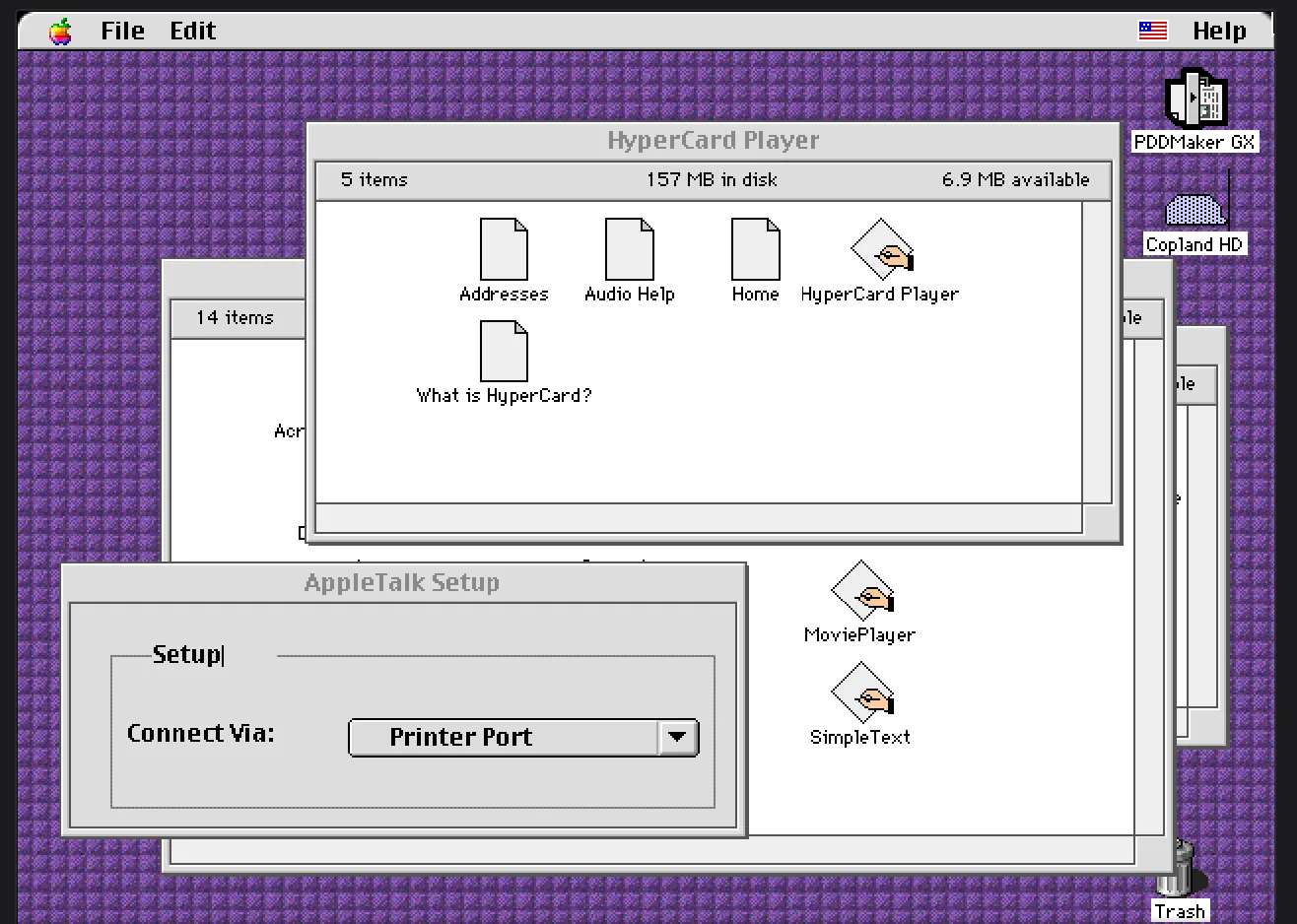
What Was Apple Copland?
Copland was Apple’s planned next-generation Mac OS, under development from 1994 to 1996. It was named after the American composer Aaron Copland. The release planned after it, Gershwin, was named after composer George Gershwin.
By the early ’90s, the classic Mac OS was showing its age. System 7 still relied on:
- Cooperative multitasking, where one misbehaving app could freeze the whole computer
- No memory protection, so a single crash often meant a full restart
- Large amounts of legacy 68k code, even on new PowerPC Macs
Competitors were moving ahead. Windows NT, OS/2, and Unix workstations already offered modern operating system features. Microsoft’s Windows 95 was on the way. Apple needed an answer, and Copland was supposed to be it.
The Road to Copland
Copland wasn’t Apple’s first attempt at a modern OS. Earlier efforts included:
- Pink, an object-oriented OS project that became Taligent, a joint venture with IBM
- Star Trek, an experimental port of System 7 to Intel x86 hardware
Neither replaced System 7. With Copland, Apple chose a more practical approach: evolve the existing Mac OS piece by piece instead of starting over, keeping compatibility with existing Mac software.
Planned Features of Mac OS 8 (Copland)
Apple’s plans for Copland were ambitious. Key features included:
1. A New Microkernel
At the heart of Copland was a new microkernel called NuKernel. It was designed to bring modern operating system services to the Mac, including:
- Preemptive multitasking for new, Copland-native software
- Protected memory for system services and drivers
- Virtual memory and improved memory management
- A native PowerPC foundation
2. Compatibility with Classic Mac Apps
To protect users’ existing software, older Mac applications would run together in a shared environment on top of the new kernel. This meant classic apps would keep working, but they wouldn’t get the full benefits of the new architecture. This compromise turned out to be one of Copland’s biggest problems.
3. A Multithreaded Finder
The Copland Finder was rewritten so users could keep working while files were copied in the background, a big improvement over the System 7 Finder.
4. Themes and a New Look
Copland introduced a customizable appearance system with multiple themes. Users could change the look of windows, menus, and controls across the system, Apple previewed themes such as Platinum, but the shipping Mac OS used Platinum alone. Extra Apple themes appeared only in Mac OS 8.5 betas, which left third-party tools like Kaleidoscope to fill the gap.
5. Smarter Search and Usability Features
Other planned Copland features included:
- Find by content, letting users search inside documents rather than just by file name
- Spring-loaded folders that opened automatically when you hovered a dragged file over them
- Multiple user support with individual settings
- Improved Open and Save dialogs
- Apple Guide 3.0 help and built-in OpenDoc support
Why Was Copland Canceled?
Despite its promise, Apple Copland fell apart. Several problems combined to sink it.
1. Scope Creep
The feature list kept growing. Teams across Apple wanted their technologies included in Mac OS 8, which made the project harder to finish and stabilize.
2. Missed Deadlines
Apple first targeted mid-1996 for Copland, then late 1996, and by October 1996 the date had slipped to “sometime” in 1997. Each delay hurt Apple’s credibility with developers and customers.
3. The Compatibility Problem
Supporting decades of classic Mac software meant much of the old, fragile system code still had to run inside Copland. Getting both stability and full compatibility proved extremely difficult.
4. Unstable Developer Releases
Apple demonstrated Copland at its 1995 and 1996 Worldwide Developers Conferences, and the 1996 lab demos crashed again and again. In August 1996, “Developer Release 0” went to a small group of selected partners. It crashed so often that it was unusable for real development work.
5. Apple’s Business Troubles
Apple was losing money and market share in the mid-’90s. Under CEO Gil Amelio, the company couldn’t afford an endless OS project. Amelio brought in Ellen Hancock from National Semiconductor to run engineering. She quickly concluded that Copland could never ship, and Apple canceled it in August 1996.
What Happened After Copland?
Salvaging Copland Features
Many Copland ideas weren’t wasted. Apple moved them into regular Mac OS updates:
- Mac OS 7.6 (January 1997) was the first release officially named “Mac OS” instead of “System”
- Mac OS 8 (1997) brought the multithreaded Finder, spring-loaded folders, contextual menus, and the new Platinum appearance
- Mac OS 8.5 (1998) added Sherlock for find-by-content searching, an updated Appearance Manager, and Navigation Services for new Open and Save dialogs
Even though the Mac OS 8 that shipped used the same name, it was not Copland. It was an update to the classic Mac OS that included pieces of Copland.
The Search for a New OS
Without Copland, Apple looked outside the company for a modern operating system. The two leading candidates were:
- BeOS from Be Inc., led by former Apple executive Jean-Louis Gassée
- NeXTSTEP from NeXT, the company Steve Jobs founded after leaving Apple
On December 20, 1996, Apple announced it would acquire NeXT for $429 million in cash. The deal closed in February 1997. The deal brought Steve Jobs back to Apple, along with the NeXTSTEP technology that became Rhapsody and, eventually, Mac OS X in 2001.
Legacy of Apple Copland
1. The Push Toward Mac OS X
Without Copland’s failure, Apple might never have bought NeXT. In that sense, Copland indirectly led to Mac OS X, macOS, and even iOS.
2. Features That Lived On
The multithreaded Finder, spring-loaded folders, content search, and themes were all planned for Copland and shipped in later versions of the Mac OS.
3. A Lesson in Software Projects
Copland is often cited as an example of how scope creep, shifting goals, and compatibility demands can sink even a well-funded software project.
4. A Collector’s Curiosity
Today, surviving Copland developer release builds are studied by retro computing fans and Mac historians, offering a glimpse at the Mac OS that almost was.
Conclusion
Apple Copland was meant to save the Macintosh. Instead, it became one of the most famous canceled projects in tech history. Its features lived on in Mac OS 8 and 8.5, and its failure set the stage for Steve Jobs’ return and the creation of Mac OS X.
For anyone interested in retro Apple history, Copland is a key part of the story of how the modern Mac came to be.
Apple Copland FAQs
What was Apple Copland?
Apple Copland was the code name for Apple’s planned next-generation Macintosh operating system, intended to ship as Mac OS 8. It was developed between 1994 and 1996 and promised modern features like preemptive multitasking and protected memory, but it was canceled before release.
Why was it called Copland?
Copland was named after American composer Aaron Copland. Its planned successor, Gershwin, was named after composer George Gershwin.
Was Copland the same as Mac OS 8?
No. Copland was originally meant to be Mac OS 8, but after it was canceled, Apple released a different Mac OS 8 in 1997. That version was an update to the classic Mac OS that included some features developed for Copland.
When was Copland canceled?
Apple canceled Copland in August 1996, under CEO Gil Amelio, after engineering head Ellen Hancock concluded it could never ship.
Why did Copland fail?
Copland failed because of a growing feature list, repeated delays, the difficulty of keeping compatibility with classic Mac software, unstable developer builds, and Apple’s financial problems in the mid-1990s.
What features from Copland made it into later Mac OS versions?
Several Copland ideas shipped in later releases. Mac OS 8 included the multithreaded Finder, spring-loaded folders, and the Platinum appearance. Mac OS 8.5 added Sherlock content searching and Appearance Manager theme support.
Did Copland ever get released to the public?
No. Copland was never released to consumers. Only limited developer release builds were distributed to selected developers, and some of those builds survive today in the retro computing community.
What replaced Copland?
After canceling Copland, Apple acquired NeXT in a deal announced in December 1996. NeXTSTEP became the basis for Rhapsody and eventually Mac OS X, which launched in 2001.
What was Gershwin?
Gershwin was the code name for the Mac OS release planned to follow Copland, expected to add even more advanced features. Gershwin was never built in any meaningful form and was abandoned along with Copland.